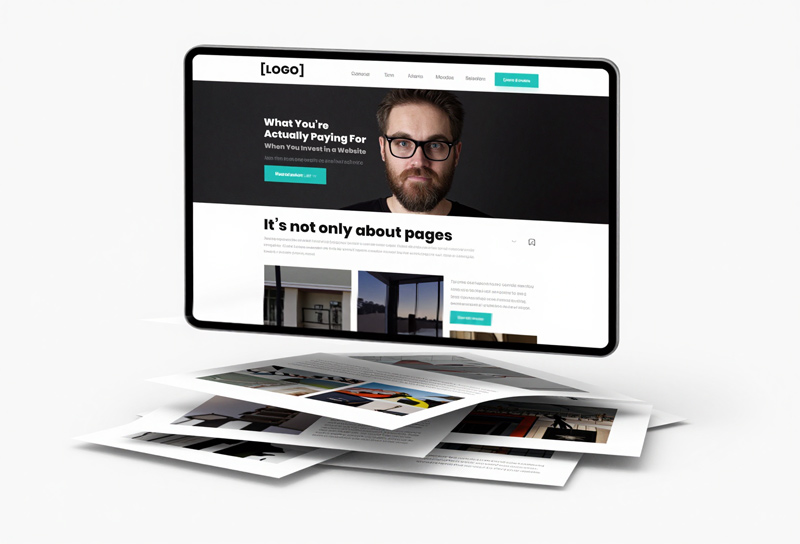
Most people think a website is expensive for the wrong reasons. They look at it and see pages, images, and a few sections put together. From the outside, it doesn’t seem like something that should cost much. And to be fair, if that’s all a website is, they’re right.
But that’s not where the cost comes from.
A website becomes expensive the moment it’s expected to do something important. Not just exist or look decent, but actually work. Because now it has a job. It has to explain your business to someone who has never met you, in a short amount of time, without confusing them or losing their attention.
That sounds simple until you try to do it properly.
Most websites fail at this quietly. Nothing breaks, nothing crashes, but people leave. No message, no feedback. They just move on to the next option. That’s the part most businesses don’t see.
When someone hears about your business, their next move is predictable. They look you up. Before they call, before they message, they check your website. And within seconds, they’re making small decisions. Do I understand this? Does this feel right for me? Do I trust this enough to take the next step?
If the answer isn’t clear, they don’t try harder. They leave.
That’s why a website isn’t just information. It’s perception. It’s your first conversation, happening without you in the room.
A lot of people still think websites are mostly assembly work. You take text, add images, place things into sections, and that’s it. If that’s the expectation, then yes, it should be cheap. But the real work isn’t placing things. It’s deciding what deserves to be there in the first place.
What needs to be said immediately, and what can wait. What’s helpful, and what’s just noise. What’s clear to you, but confusing to someone seeing your business for the first time.
Those decisions are constant, and they’re not obvious. When they’re done well, the site feels simple. Almost too simple. That’s usually a sign that a lot of thinking went into it.
There’s a line I come back to often: confusion is the most expensive thing you can put on a website. Not because it looks bad, but because it quietly kills interest. You can have strong visuals, good branding, even a solid offer, but if someone has to pause and figure things out, the moment is gone.
Clarity isn’t decoration. It’s function.
And getting to clarity takes restraint. It means removing things that feel important internally but don’t actually help the visitor. It means saying no to elements that look impressive but don’t move anything forward. That’s where most of the effort goes. Not into adding more, but into deciding what not to include.
This is also where expectations start to misalign. Most clients think they’re paying for what they can see. Pages, layout, design. But that’s not really the product.
The product is how everything is structured so it makes sense to someone new. It’s how attention is guided without feeling forced. It’s how the site answers questions before they’re even asked. It’s how it feels easy to move through, without stopping to think about what to do next.
None of that stands out on its own, but you feel it immediately when it’s missing.
Simple websites are often assumed to be easier. They’re not. Busy websites are easy because you can keep adding until the space is filled. Simple ones require decisions. This matters, that doesn’t. This comes first, that can wait.
There’s no hiding behind volume. Every element has to justify itself. That’s where experience shows up, not in how much is added, but in what’s left out.
One of the more confusing things is that you can’t always see the difference between a standard website and a well thought out one. Some cheaper sites look impressive at first glance. Some stronger ones look almost plain. Because effectiveness doesn’t always look impressive. It looks obvious.
A site that works well often feels like there was no other way it could have been structured. That’s not accidental.
There’s also a shift happening with content. A lot of businesses now use AI to generate website text, which is completely fine. I use it too. But there’s a difference between having words and having direction.
Generic content tends to say everything and nothing at the same time. It sounds polished, but it doesn’t guide. It doesn’t help someone decide. It doesn’t remove doubt. And that’s the whole point of the website.
The wording doesn’t need to be clever. It needs to be clear. Clear enough that someone doesn’t have to think twice.
At the end of the day, your website is doing work for you constantly. It’s answering questions you didn’t hear, building trust or weakening it, attracting the right people or letting them slip away. All of that happens before you even know someone was considering you.
A good website makes your business easier to run. It reduces unnecessary conversations, filters out poor-fit enquiries, and helps the right people feel confident enough to move forward.
That’s where the value is. Not in how it looks, but in how it performs when you’re not there to explain things.
A professional website costs more because it carries more responsibility. It has to be clear, feel right, and guide people without friction. That doesn’t come from adding more. It comes from thinking harder about less.
And that’s what you’re actually paying for.