A client sent me a website someone else had already “built” for him.
At first glance, it looked good. Clean layout, modern fonts, nice spacing. The kind of site that checks all the surface-level boxes. But after a minute or two, it started to feel like walking into a beautifully designed restaurant where there’s no smell coming from the kitchen.
Everything looks right.
But nothing feels alive.
The structure was generic. The messaging could apply to almost any business. The images looked impressive but didn’t say anything real. It was a website in appearance, not in function.
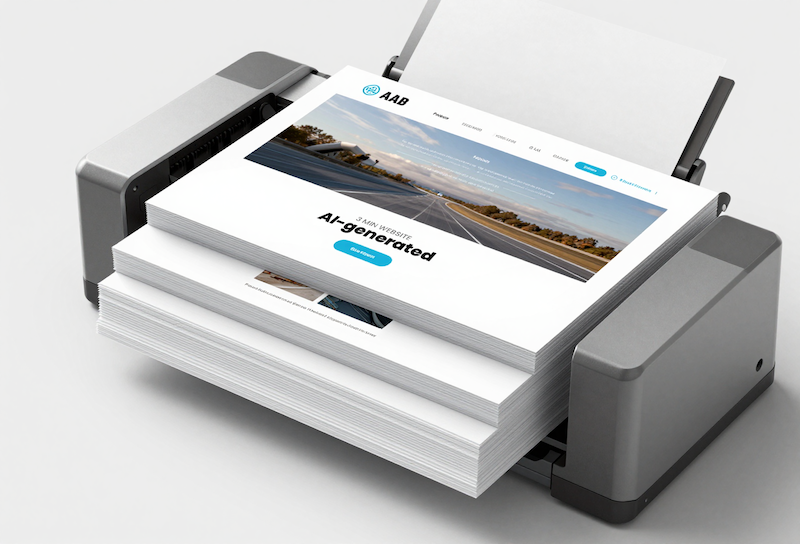
It had been generated using AI.
Now to be clear, AI isn’t the problem. I use AI in my own process. But I use it very differently to how most of these “instant website” builds are being done.
I don’t use AI to build the final product. I use it to speed up the parts that should be faster.
For example, I’ll use AI to research competitor websites, pull references, and explore different layout directions. It helps me gather ideas that would normally take hours. But then I step in and make decisions based on experience, context, and what actually makes sense for the client.
AI gives options.
Experience makes choices.
And that difference is where most AI-generated websites fall apart.
Why They All Start to Feel the Same
AI doesn’t understand your business. It understands patterns.
So when it generates a website, it’s pulling from thousands of existing sites and averaging them out. That’s why you keep seeing the same structure over and over again. A broad headline that sounds nice but says very little. Sections stacked in a predictable order. Clean visuals that don’t take any real position.
It’s not bad design. It’s just safe design.
And safe design is forgettable.
A good website should feel specific. It should make it immediately clear who it’s for and why it matters. AI can’t really do that, because it doesn’t know what actually makes your business different. It just fills in what’s most likely to “look right.”
That’s how you end up with websites that pass the glance test but fail the second look.
“But It Was Done in Minutes…”
This is usually where the comparison starts.
If a website can be generated in minutes, why does a proper one take longer?
Because the time isn’t in placing elements on a page. It’s in deciding what those elements should say, where they should go, and why they matter.
A website isn’t just design. It’s structure, messaging, flow, and intent. It’s understanding what a visitor needs to see first, what builds trust, and what moves them to take action.
AI skips that thinking step. It gives you something that looks finished without actually being resolved.
And that creates a false sense of completion.
The Part No One Talks About: What Happens After
Most AI-generated websites look fine on day one.
The problems show up later.
Many of them aren’t built on a proper content management system. That means updating content, adding pages, or making changes becomes frustrating quickly. Small edits start breaking layouts. New ideas become difficult to implement.
Over time, the site starts drifting. Sections get inconsistent. Content gets patched in. What started as “quick and easy” slowly turns into something harder to manage than if it had been built properly from the start.
I’ve seen this play out more than once.
One client came to me after going the “quick AI route.” He had something up and running, which felt like a win at the time. But as soon as he needed to update it, everything became a workaround. Simple changes weren’t simple anymore.
We ended up rebuilding the site properly, with a structure he could actually manage. In the end, he spent more than he would have if we had just done it right from the beginning. The difference was that this time, he understood what he was paying for.
And more importantly, he could finally use his website instead of fighting it.
AI vs Templates (An Honest Take)
Here’s a perspective most people don’t expect.
If the goal is to get something up quickly and affordably, you’re often better off buying a solid website template and customizing it than generating a site entirely with AI.
A good template is built with structure in mind. Navigation makes sense. Pages are consistent. It’s designed to be edited and extended.
AI-generated sites, on the other hand, often look structured but aren’t built with real flexibility underneath.
So ironically, the “more advanced” option can leave you more limited.
SEO, Images, and the Illusion of Progress
AI can generate text. It can generate images. It can fill a website very quickly.
But filling a website is not the same as building one.
SEO isn’t about having words on a page. It’s about saying the right things in the right way, based on what your audience is actually searching for. That requires context and intent, not just output.
The same applies to images. AI visuals can look polished, but they often lack relevance. They don’t show your work, your environment, or anything that builds real trust. They make the site look complete without making it more convincing.
It’s progress on the surface, not in substance.
Where AI Actually Fits (And Where I Use It)
AI is incredibly useful when it’s used with intent.
In my process, it helps speed up research, generate starting points, and explore different directions quickly. It allows me to look at what competitors are doing, identify patterns, and then deliberately improve on them.
What it doesn’t do is replace the thinking.
The decisions around structure, messaging, and flow are still made manually, based on experience and what will actually work for the business. That’s the part that determines whether a website performs or just exists.
Final Thought
If someone shows you an AI-generated website, it’s worth asking a simple question.
Does this feel like a real solution, or does it just look like one?
Because those are very different things.
A website should not only look good, it should make sense, adapt over time, and support your business as it grows. That requires more than speed. It requires structure, clarity, and deliberate decisions.
If the goal is just to have something online, AI can get you there.
If the goal is to have something that actually works, it takes a bit more than that.