It usually starts the same way. A client sends me a logo they generated using AI and asks, “Can you clean this up or redo it?” It’s a fair question. AI tools are fast, easy to use, and they can produce something that looks like a logo in seconds. On the surface, it feels like a smart shortcut.
The problem only shows up later.
At first glance, the logo often looks fine, sometimes even impressive. But logos are not designed for a quick glance. They need to work everywhere, from websites and social media to signage, packaging, and print. That is where things start to fall apart.
Most AI logos try to do too much. There are too many ideas competing for attention, too many effects, and too much detail. Instead of being clear and recognisable, the result becomes noisy and inconsistent. It might look interesting for a moment, but it does not hold up when used in the real world.
The real test comes when you start pushing the logo beyond that first impression.
Zoom in, and the cracks appear. Lines are uneven. Spacing feels off. Shapes don’t quite connect the way they should. Small distortions start to show up. On their own, they seem insignificant. But together, they create a subtle sense that something isn’t right. Most people cannot explain it, but they feel it. And that feeling affects trust.
Then come the practical problems.
This particular logo needed to be embroidered onto shirts. That is where complexity stops being a style choice and becomes a limitation. Fine detail gets lost, shapes merge, and what looked intricate on screen turns into something muddy and unreadable in thread.
On top of that, there was no proper vector file to work from. Which means the logo could not be scaled, adjusted, or reproduced reliably. Even something as simple as placing it on a white background became a problem. The original design relied too heavily on effects and contrast that did not translate outside of that one setting.
At that point, “fixing” is no longer the right word.
What follows is a reconstruction.
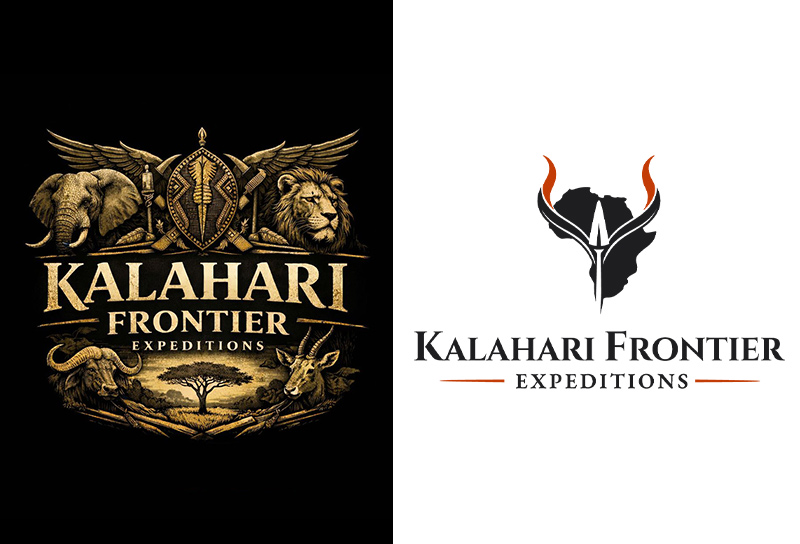
I recently worked with a client in exactly this position. They came to me with an AI-generated logo and asked if I could vectorise it. On the surface, it looked detailed and impressive. But once you started zooming in and thinking about how it needed to be used, the issues were everywhere.
Instead of trying to patch it, we stepped back and focused on what the brand actually needed to communicate. The brief was clear. This was about heritage, trust, and refined luxury, not visual overload.
The result was a simpler, more intentional logo built from the ground up. One that could be embroidered cleanly, scaled without breaking, and used across different backgrounds without falling apart. I created a full set of variations as well, including light and dark versions, colour options, and different layouts so the logo works whether it is on a website, a shirt or something small and circular.
Same business. Same story. Completely different outcome
A good logo is not a single file. It is a system. It needs to adapt to different contexts without losing its identity. It needs to be flexible, consistent, and built with real-world use in mind from the start.
AI does not think about any of that. It generates based on patterns, not purpose.
If you already have an AI-generated logo, it is not a mistake. It can be a useful starting point. But if you are serious about your business, the smarter investment is to build something properly from the beginning. That way, you are not paying to fix hidden problems later. You are creating something that works everywhere from day one.
At the end of the day, people do not analyse your logo. They react to it. And small details, clutter, and imperfections send a message whether you realise it or not.
Your logo should communicate confidence, not compromise.